After an early morning scare [read; 4:50AM call from a 1-800 number informing me that my flight had been cancelled] I am en-route to Tucson AZ for the USAT Duathlon National Championships. I’m flying through Dallas instead of Chicago, and arrive an hour later than planned. Hardly a stressor at all. Unfortunately, my girlfriend Caitlin is holed up in Ann Arbor studying for her law exams, but I’m happy to be traveling with Jenn Finn and Jason Palmer, multisport athletes and members of Team Greater > Than, a recently launched team/community of endurance athletes out of the Ann Arbor, MI area. As a brief aside; if you are an endurance athlete interested in becoming affiliated with a team, don’t hesitate in reaching out to me. We have a great initial roster, an amazing tally of sponsors and partner organizations, and we feel primed to accomplish big things fast.
The race isn’t until Saturday, so I’ll have plenty of time to settle in and shake off what will end up having been a 10-hour travel day. In addition to enjoying Tucson, a place that I have never been, the extra time will also allow me to preview the bike and run course. This will help me figure out gearing on the bike and pacing on the run -- all in an effort to minimize surprises on race morning.
In terms of pre-race thoughts, I actually don’t have many. Excitement will undoubtedly be running high. The field is strong and filled with many of the best duathletes in the country, so this will be a great chance for me to see how and where I stack up. Although there will probably be some nerves, I honestly don’t anticipate that being much of an issue. For almost all endurance athletes, racing literally makes up [at most] 1-2% of the total time spent in our respective sports. The other 99% percent is the process of getting to the start-line. In daily speak, this process piece is commonly referred to as “training” and encompasses far more than the physical exertion involved in running and biking workouts. It is a litany of daily decisions that includes not only how hard I am going to run my next mile repeat, but also everything from what I put into my body, to how often I stretch, to how much I sleep.
How does this relate to nerves, or lack thereof? In an attempt to make the connection, I’ll share with you what is probably the best piece of advice my coach has ever given me: “Trust your training.” During the build-up [which started in Dec] to this upcoming month of races, I have been consistent, focused, and given strong efforts in physical workouts. Off the bike and the road, I have been pretty good too, with a real concentration on getting enough sleep and eating the right foods at the right times. I’ve been far from perfect, and to be honest, haven’t had too many remarkable days, but I’ve been steady. Maybe the most telling sign that I have done something right; I haven’t missed a single workout due to injury or illness in the last 180 days. This is actually somewhat shocking, and when I look back at my training log, the thing that I am most proud of.
Even against that backdrop, is there a chance that I still question myself over the next month? Absolutely. It’s human nature. But, if I catch that happening, I will fall back not only on the leg strength that results from 5-hour workouts and 18-hour weeks, but also on the mental strength and confidence. With all that “training” sunk into my legs and my mind, there really isn’t much to worry about.
Aside from the sheer bad luck of a crashing or getting a flat tire, endurance sports are pretty democratic. Once you establish your genetic baseline, beating yourself is simply a manifestation of the training process. And since I can’t control the genetics of the field at any race, my goal is to keep beating myself. If I can do that, beating others will take care of itself. Following that logic, if I “win” the process of getting to the start-line, I should “win” the majority of races I compete in. Trust your training.
Along those lines, I am a big believer in using key words/phrases/mantras to bring myself back to a mindful and fully aware place. At race weekends on the horizon, my mantra will be “realize,” which literally means to bring to fruition or to make real. I’ve put in the work, and now, I’ll make it real and tangible by testing myself against the most honest broker of all; time.
So, over the next month, I look forward to both realizing and celebrating my training in four short-course races. I am well rested and the physiological and psychological adaptations to my training have sunk in. Coach Doug MacLean [who I owe a good part of my success to] has built a schedule that will bridge me from race-to-race, balancing the need to recover with the need to stay sharp in just 6-day increments. Racing consecutive weekends like this is far from conventional. But in my case, it makes sense:
- I want to ride out the fitness I have built and gain more experience in race situations
- The race distances are short enough that I should be able to recover from them
- I will be taking some time off in early June when I settle into Salt Lake City [where I will be doing a summer internship at Intermountain Health Care]
- When I ramp back up, I’ll re-enter a base building phase and switch my preparation to focus on long-course races in the Fall [formats like 6mile/50mile/6mile versus 3mile/20mile/3mile]
That is what is on my mind heading into spring race season. By the end of May, I’ll know where I stack up both nationally, and in the state of Michigan. While I won’t lie and say that those things matter to me [because they do], I’m already pretty happy that, on balance, I’ve “won” the process of getting here. Let the party start!
I’ll do my best to post short race-reports after each event. A race calendar is below.
Train hard, live hard!
Brad
Race Calendar:
- Saturday, April 30: USAT Duathlon National Championships [5K/35K/5K] Tucson, AZ
- Saturday, May 7: Willow Duathlon [5k/20k/5k] New Boston, MI
- Friday May 13 to Sunday May 15: Starkerman Epic Challenge [multi-race weekend involving a 5K, mid-distance triathlon, 40K cycling time-trial, and short-course duathlon] Gaylord, MI
- Saturday, May 21: Gross Ile Duathlon [5K/25k/5k] Gross Ile, MI
Wednesday, April 27, 2011


Monday, April 11, 2011
Getting Through Big Blocks of Training
I am thrilled to have finished my 14-day “overload” period of training with a stretch of extremely strong workouts. Now, as my training phases down prior to a stretch of races in late April and May, my focus shifts from “get through monster weeks,” to “recover smart and stay sharp for key workouts.” While the latter is still ahead of me and requires a special kind of discipline and focus, I’m happy to be done with the former! To that end, while things are still fresh [in my mind, certainly not my legs], and with Spring "peak-time" here for so many athletes, I figured I would share a few thoughts on getting through big blocks of training. I lead by giving a brief rundown of my recent training [and the birth of these insights] and then offer some tips in two categories: physiological and mental. If you're short of time or attention, feel free to skip to the latter part of the post for top value!!
First, to set some context: My training program is built to peak three weeks prior to my first big race. The two weeks leading up to that point are “overload” weeks, in which both volume and intensity reach high points of the training cycle, and in this case, of my athletic life! To give you a brief sense of what that looks like, I’ll share my schedule from the last four days of the 14 day block:
Thursday Morning - 5x1 mile [running] repeats at max effort
Thursday Afternoon - 1:45 ride with 2x20 min at threshold
Friday - 35 min run, 1:30 transition ride [all at recovery exertion]
Saturday - 80 mile bike [with the last hour at threshold], 35 min transition run
Sunday - 1:30 bike ride [including power intervals], 1:30 transition run [last 40 min at tempo pace]
It’s all relative, but for me, this was pretty enormous, and while the [above] final stretch was the “biggest,” the 10 days preceding didn’t look all that different. As I mentioned in opening, I couldn’t be happier with how things went, as [I must admit, somewhat surprisingly] I posted some of the best numbers of my life in those last few workouts!
So now that you know where I’m coming form, a few thoughts on getting through big blocks of training: Physiological aspects first
Sleep: A majority of recovery happens during sleep. If you don’t sleep, you don’t recover, and you set yourself up for a pretty vicious cycle. Listen to your body, and don’t be embarrassed to check-out at 9:30PM if that is what it’s telling you to do. Of course, sometimes other obligations cannot be moved, but if you’re fighting to keep your eyes open so you can watch Jersey Shore, or even Anderson Cooper, hit the sack instead.
Nutrition: Always important, but especially when pushing limits. To make it simple, you are going to need to eat a lot of high quality foods to support the work! That said, you may not have the energy to cook a lot of high quality foods. My advice here is cook in bulk and store. I started off my week by making 14 cups of brown rice, and about the same in pasta…you get the point. Stock up on Powerbars, Gus, etc [at RunningFit of course] so you won't have to worry about running out and needing to do additional errands during the week. Also worth mentioning, “peak time” generally means “race-weight time.” If you need to drop a pound over two weeks, that will probably happen naturally given the increasing volume and intensity of training. But, if you are trying to make up for lost ground by cutting significant weight, now is not the time. If you skimp nutritionally during these periods, you set yourself up for low quality workouts, and worse, injury. Most people are much faster at 155lbs than at 150lbs with acute injuries and chronic fatigue.
Keep the parts up: While sleeping enough and eating right does wonders for the “whole,” it’s pretty inevitable that the “parts” may need some extra attention. I know it’s a huge pain, but ice the sore spots regularly. Bags of frozen peas are cheap, work great and last for months. Prioritize stretching. Trust me, the last thing I want to do after a 5 hour workout is spend 15 minutes stretching, but think of it like this: at that point, the marginal value from 15 minutes stretching is probably greater than any of the prior 300 minutes! Remember how nervous you get when sore spots arise during a workout [e.g., your IT tightens up around your knee], and then think twice about skipping stretching. Get a massage. I’m a huge believer in the power of massage to expedite recovery and prevent injury.
Just as important, the Mental aspects
Think workouts, not days, and definitely not weeks: Plan your schedule [for logistical matters] around the week, but after you do that, try to forget about everything but the training session in front of you. This type of thinking is hard to engender, but the approach a) makes the challenge of an overload period much more manageable and b) allows you to be fully present and focused on the current workout.
Remember, training and its effects are cumulative: Not every workout is going to be your best. As a matter of fact, it is likely that you may have some pretty crappy ones. Who wouldn’t after training so hard for a consecutive stretch? A whole manner of research shows that fitness gains take anywhere from 10-21 days to set in. “Get through,” the monster training blocks, and then let everything sync-in as your body adapts during your phase-down/taper/etc. Your performance at priority races [when you are well-rested] is the best standard by which to judge your training. Do not try and judge each and every workout [for more on this, see my prior post “The Unimportance of Speed.”] This isn’t to say just go through the motions! Give training sessions the effort they require, but don’t stress over the pace on your watch.
Keep the goal(s) in mind: Insert little reminders of big races into your training routine. This helps maintain motivation, and also balances a “thinking workout” mindset with one that remembers that “training is cumulative.” Each individual workout has a purpose, which in aggregate, compounds over time to set you up for success on race days.
Celebrate little victories: Create some “checkpoints” [for instance, after a tough stretch of workouts, or maybe at the end of a week] during overload periods, and use them to not only evaluate your progress, but just as important, to celebrate the work you have done. Crack your favorite bottle of wine. See what those Lobsterfest commercials are all about. Get the strawberry cheesecake pancakes at Ihop! Don’t go overboard, but do unbutton a bit. All of a sudden, if you move from workout-to-workout, and then checkpoint-to-checkpoint, the monster training block actually goes by kind of fast.
I hope you enjoyed reading, and maybe even picked up a thing or two to implement in your own training. While there is no single equation for how to get through big blocks of training, there seem to be a few overarching principles that center on supporting the training physically and mentally. Figure out what works for you, and do your best to stick with it. As for me, I’m planning on ending this recovery week with a small Duathlon race in Ohio. It will be a great chance to work through transitions and identify any kinks that need to be worked out. Look for a race-report update early next week!
Stay tuned, and until next time, Train Hard, Live Hard!
First, to set some context: My training program is built to peak three weeks prior to my first big race. The two weeks leading up to that point are “overload” weeks, in which both volume and intensity reach high points of the training cycle, and in this case, of my athletic life! To give you a brief sense of what that looks like, I’ll share my schedule from the last four days of the 14 day block:
Thursday Morning - 5x1 mile [running] repeats at max effort
Thursday Afternoon - 1:45 ride with 2x20 min at threshold
Friday - 35 min run, 1:30 transition ride [all at recovery exertion]
Saturday - 80 mile bike [with the last hour at threshold], 35 min transition run
Sunday - 1:30 bike ride [including power intervals], 1:30 transition run [last 40 min at tempo pace]
It’s all relative, but for me, this was pretty enormous, and while the [above] final stretch was the “biggest,” the 10 days preceding didn’t look all that different. As I mentioned in opening, I couldn’t be happier with how things went, as [I must admit, somewhat surprisingly] I posted some of the best numbers of my life in those last few workouts!
So now that you know where I’m coming form, a few thoughts on getting through big blocks of training: Physiological aspects first
Sleep: A majority of recovery happens during sleep. If you don’t sleep, you don’t recover, and you set yourself up for a pretty vicious cycle. Listen to your body, and don’t be embarrassed to check-out at 9:30PM if that is what it’s telling you to do. Of course, sometimes other obligations cannot be moved, but if you’re fighting to keep your eyes open so you can watch Jersey Shore, or even Anderson Cooper, hit the sack instead.
Nutrition: Always important, but especially when pushing limits. To make it simple, you are going to need to eat a lot of high quality foods to support the work! That said, you may not have the energy to cook a lot of high quality foods. My advice here is cook in bulk and store. I started off my week by making 14 cups of brown rice, and about the same in pasta…you get the point. Stock up on Powerbars, Gus, etc [at RunningFit of course] so you won't have to worry about running out and needing to do additional errands during the week. Also worth mentioning, “peak time” generally means “race-weight time.” If you need to drop a pound over two weeks, that will probably happen naturally given the increasing volume and intensity of training. But, if you are trying to make up for lost ground by cutting significant weight, now is not the time. If you skimp nutritionally during these periods, you set yourself up for low quality workouts, and worse, injury. Most people are much faster at 155lbs than at 150lbs with acute injuries and chronic fatigue.
Keep the parts up: While sleeping enough and eating right does wonders for the “whole,” it’s pretty inevitable that the “parts” may need some extra attention. I know it’s a huge pain, but ice the sore spots regularly
Just as important, the Mental aspects
Think workouts, not days, and definitely not weeks: Plan your schedule [for logistical matters] around the week, but after you do that, try to forget about everything but the training session in front of you. This type of thinking is hard to engender, but the approach a) makes the challenge of an overload period much more manageable and b) allows you to be fully present and focused on the current workout.
Remember, training and its effects are cumulative: Not every workout is going to be your best. As a matter of fact, it is likely that you may have some pretty crappy ones. Who wouldn’t after training so hard for a consecutive stretch? A whole manner of research shows that fitness gains take anywhere from 10-21 days to set in. “Get through,” the monster training blocks, and then let everything sync-in as your body adapts during your phase-down/taper/etc. Your performance at priority races [when you are well-rested] is the best standard by which to judge your training. Do not try and judge each and every workout [for more on this, see my prior post “The Unimportance of Speed.”] This isn’t to say just go through the motions! Give training sessions the effort they require, but don’t stress over the pace on your watch.
Keep the goal(s) in mind: Insert little reminders of big races into your training routine. This helps maintain motivation, and also balances a “thinking workout” mindset with one that remembers that “training is cumulative.” Each individual workout has a purpose, which in aggregate, compounds over time to set you up for success on race days.
Celebrate little victories: Create some “checkpoints” [for instance, after a tough stretch of workouts, or maybe at the end of a week] during overload periods, and use them to not only evaluate your progress, but just as important, to celebrate the work you have done. Crack your favorite bottle of wine. See what those Lobsterfest commercials are all about. Get the strawberry cheesecake pancakes at Ihop! Don’t go overboard, but do unbutton a bit. All of a sudden, if you move from workout-to-workout, and then checkpoint-to-checkpoint, the monster training block actually goes by kind of fast.
I hope you enjoyed reading, and maybe even picked up a thing or two to implement in your own training. While there is no single equation for how to get through big blocks of training, there seem to be a few overarching principles that center on supporting the training physically and mentally. Figure out what works for you, and do your best to stick with it. As for me, I’m planning on ending this recovery week with a small Duathlon race in Ohio. It will be a great chance to work through transitions and identify any kinks that need to be worked out. Look for a race-report update early next week!
Stay tuned, and until next time, Train Hard, Live Hard!
Friday, March 25, 2011
Quick Update: Training in Clermont, Sarasota Half Marathon, and Peak Time on the Horizon
It's been quite some time since I gave a true training update, so I figured I would recap the last month, say a few things about where I'm at now, and then give a download on what's to come.

Where I'm at Right Now
Race season!! After the overload weeks, I have a 3-week phase down into a true taper that will get me ready for the Duathlon National Championships on April 30, as well as the rest of the month of May. Overall, this four-week block should be a really exciting time! After Nats, I am racing in 3 more local [all in Michigan] Duathlons...on consecutive weekends. I have never raced consecutively like this before, so it will be something new for me. It doesn't hurt that 2 of the 3 races are shorter distances [with only 10K total of running in each], so recovering from those [shorter, run-light races] shouldn't be too much of a problem. The plan is to do only a few intense workouts in between races, and otherwise, to focus on good recovery, and to let the last 4 months of training carry me through. It will be great experience, and I look forward to seeing where I stack up both nationally, and in the state.
Stay tuned, and until next time, Train Hard, Live Hard!
Recap of the Last Month
Training trip to Clermont Florida: This was a great time, and a very intense week of training. I put in around 17 hours of volume, with a lot of quality and higher-stress work mixed in. It was great to get off the trainer and on the road for countless reasons, but chief among them: a) this was my first chance to ride the time-trial bike outdoors and get in some good miles of handling practice and b) I almost forgot how much "fun" riding a bicycle is; the wind, pavement, and feeling of actually moving somewhere [versus watching CNN on the trainer] was really uplifting. Training with Marleigh [not indoors] was a blast, and spending time with my Coach Doug and Olympic hopeful Triathlete Ethan Brown was also really neat. I got great insight into how the elite workout, eat, and sleep, and how the importance of the later two elements of "training" rival that of the first. Other notable elements of the trip: I came too close to a gator during a tempo interval [good excuse for missing heart-rate targets], I quickly discovered why so many episodes of COPS are filmed in Florida [Vacation Village is designed to be the setting for COPS], and enjoyed sleeping between 8-10 hours a night!
Training trip to Clermont Florida: This was a great time, and a very intense week of training. I put in around 17 hours of volume, with a lot of quality and higher-stress work mixed in. It was great to get off the trainer and on the road for countless reasons, but chief among them: a) this was my first chance to ride the time-trial bike outdoors and get in some good miles of handling practice and b) I almost forgot how much "fun" riding a bicycle is; the wind, pavement, and feeling of actually moving somewhere [versus watching CNN on the trainer] was really uplifting. Training with Marleigh [not indoors] was a blast, and spending time with my Coach Doug and Olympic hopeful Triathlete Ethan Brown was also really neat. I got great insight into how the elite workout, eat, and sleep, and how the importance of the later two elements of "training" rival that of the first. Other notable elements of the trip: I came too close to a gator during a tempo interval [good excuse for missing heart-rate targets], I quickly discovered why so many episodes of COPS are filmed in Florida [Vacation Village is designed to be the setting for COPS], and enjoyed sleeping between 8-10 hours a night!
Sarasota Half Marathon: This wasn't really a priority race for me in that it came in the middle of a big training block, and thus, I only had a mini [2 day] taper for it. Nonetheless, come Thursday night of that week [start mini-t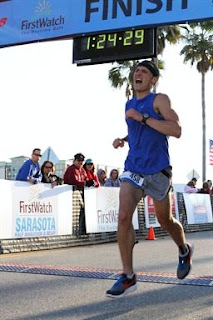 aper] I treated this like the real deal. Also, this is the only "road running" race I have on my calendar for the Spring [all my other races are Duathlons], so that added a little urgency and excitement. I went 1:24:27, or at a 6:26 pace, which was good enough for a top 20 finish, and second in my age-group [guy got me by less than a minute, and was a helluva runner]. I was really happy with this result. The race was a 3-minute PR for me at the 13.1 distance, and the pace and race execution were almost exactly as we had planned for. Two biggest positives from this race: 1) I really let the race come to me. It was quite windy early on, and my Garmin was telling me I was running 6:40 pace when the plan was to be running a 6:20 pace. Rather than get all worried or push things too hard too early, I remember taking a few deep breaths and telling myself that I would get a tail-wind [it was an out and back course] during the second half of the race. Rather than force things, I showed patience, and sure enough, I negative split the back-half. 2) I took a risk earlier than I have ever before. Normally I hold back until about the last mile for fear of going "all-out" too soon, and having a melt-down. This time around, I trusted my training [which over the past few months has been as consistent as ever] and went into suffer-mode with 2 miles to go. It hurt like hell, but my last 2 miles were the fastest 2 miles of the race, and included 2 passes [not bad when you are up toward the front group]. Ideally I will be able to do this for longer periods of time in future races, but this is a step in the right direction. It's simple to say "I'll trust my training and suffer," but much harder to do it when you are out there racing, checking your watch, figuring out potential finish times in your head, etc, etc... All in all, this was a great morning. The weather was beautiful, Caitlin race-walked a huge 10 minute PR, and my Grandma got to come out and support both of us!
 aper] I treated this like the real deal. Also, this is the only "road running" race I have on my calendar for the Spring [all my other races are Duathlons], so that added a little urgency and excitement. I went 1:24:27, or at a 6:26 pace, which was good enough for a top 20 finish, and second in my age-group [guy got me by less than a minute, and was a helluva runner]. I was really happy with this result. The race was a 3-minute PR for me at the 13.1 distance, and the pace and race execution were almost exactly as we had planned for. Two biggest positives from this race: 1) I really let the race come to me. It was quite windy early on, and my Garmin was telling me I was running 6:40 pace when the plan was to be running a 6:20 pace. Rather than get all worried or push things too hard too early, I remember taking a few deep breaths and telling myself that I would get a tail-wind [it was an out and back course] during the second half of the race. Rather than force things, I showed patience, and sure enough, I negative split the back-half. 2) I took a risk earlier than I have ever before. Normally I hold back until about the last mile for fear of going "all-out" too soon, and having a melt-down. This time around, I trusted my training [which over the past few months has been as consistent as ever] and went into suffer-mode with 2 miles to go. It hurt like hell, but my last 2 miles were the fastest 2 miles of the race, and included 2 passes [not bad when you are up toward the front group]. Ideally I will be able to do this for longer periods of time in future races, but this is a step in the right direction. It's simple to say "I'll trust my training and suffer," but much harder to do it when you are out there racing, checking your watch, figuring out potential finish times in your head, etc, etc... All in all, this was a great morning. The weather was beautiful, Caitlin race-walked a huge 10 minute PR, and my Grandma got to come out and support both of us!
 Where I'm at Right Now
In a recovery week that ends with a race-simulation this weekend, which will mirror the Duathlon National Championship distances. With that big race being only 5 weeks out, this will be a good chance to work through transitions, and see how my body reacts to the pacing that my coach and I think is appropriate given my current level of fitness. After that, I have 2 "overload" weeks where the volume and intensity of my training will peak. It will be very important to focus on nutrition and recovery during these weeks. Luckily, I'm in a real good spot with school, and exams are not until after this brutal 14 day stretch, so I should be able to minimize stress and concentrate on getting through this. These are weeks that you love to hate, and honestly, hate to love [or even like].
What's to Come
Race season!! After the overload weeks, I have a 3-week phase down into a true taper that will get me ready for the Duathlon National Championships on April 30, as well as the rest of the month of May. Overall, this four-week block should be a really exciting time! After Nats, I am racing in 3 more local [all in Michigan] Duathlons...on consecutive weekends. I have never raced consecutively like this before, so it will be something new for me. It doesn't hurt that 2 of the 3 races are shorter distances [with only 10K total of running in each], so recovering from those [shorter, run-light races] shouldn't be too much of a problem. The plan is to do only a few intense workouts in between races, and otherwise, to focus on good recovery, and to let the last 4 months of training carry me through. It will be great experience, and I look forward to seeing where I stack up both nationally, and in the state.
Stay tuned, and until next time, Train Hard, Live Hard!
Wednesday, March 2, 2011
The Unimportance of Speed
It’s great to be training down in Clermont Florida, where it has been 75 and sunny every day. A huge impetus for taking this trip [amongst many other things] was to create an opportunity to ride my new time-trial bike outdoors before Duathlon Nationals and the May races [in Michigan] that I have on my calendar. For those of you who may be unfamiliar, to make a long story short, a “time-trial” bike has a much more aggressive geometry/fit than a road bike, and as a result, it handles much differently [e.g., one has a lot less control on a TT bike vs. a road bike, but also the potential to go much faster].
My first hard training session of the trip involved a 1:20 bike ride that included speed sets, or 2x10 minutes of best-sustainable-effort [2 episodes of near all-out riding with 3 minutes rest in between], followed by a 30 minute transition run; the first mile at a tempo effort, everything else relaxed thereafter. I averaged around 24mph for the bike speed sets, and then ran a 5:55 first mile off the bike. For me this is incredibly fast -- by far the fastest I have ever been. I wasn’t sure if it was the new bike, the improved legs [payoff from seemingly endless winter hours on the trainer] or some combination of the two. In any event, I was stoked, and excited to report the results to my coach. His response went something like this: “Don’t matter Brad, I just want to know where your heart-rate was at.”
After giving him my heart-rate data [which was also quite good, as my legs were able to sustain an extremely high heart-rate during the intense parts of the workout], I pushed a bit harder on his whole “non-reaction” to the enormous speed gains from any workout that I did last year. I got nothing from my coach but a reminder that I did the workout on flat terrain [plus for speed], in wind conditions that will never be exactly the same again [who-knows for speed], and only two days after running a 10K at race-effort [minus for speed].
 Taken together, speed tells us very little to nothing, and is an awful proxy for judging workouts. Too many factors outside of one’s effort and current fitness impact and determine speed. It’s actually an extremely long list, but the best and most clear examples of some confounding variables are:
1) Wind condition
2) Course profile/grade and
3) What you did in the days leading up to the workout [e.g., are you well-rested].
To really drive the point home: it’s much better to go 23mph on a windy day over rolling terrain after doing a hard workout two days prior than it is to go 26mph with the wind at your back on a flat course after a week of easy training. Although the speed feedback implies that the second workout was much better, odds are, our hypothetical athlete was probably pushing his/her body harder in the first example. And if training sessions are judged by the physiological and mental adaptations that they foster, than the first workout was superior and the one to be celebrated.
This is true of biking and running, and I’m sure in many other sports too. This is also why almost all coaches and training programs use heart-rate, power, perceived exertion, or pace bands [forgiving pace ranges] to guide workouts, and why how you feel after a workout [are you sore and beat after a hard effort...or refreshed after a recovery workout] is more important than the speed on your Garmin. This is also extremely counter-intuitive, and a hard chasm for data-driven, improvement oriented, speed junkies to cross. But, once crossed, you’ll be more likely to choose more challenging terrain for your workouts and get more out of them, and you'll be less likely to stress over a number that really is rather arbitrary and I’d say anywhere from 20-30% out of your control depending on the day (unless you can control the wind and things like that).
Small caveat here, there are some times when speed is extremely important. For instance, if you are trying to qualify for the Boston Marathon or some other race that uses speed as a standard [pick a flat course, hope for no wind, and taper properly], or, if you are doing indoor training on the same course under the same rest conditions [e.g., weekly 400 repeats inside after two easy days] then speed matters and can be useful as training data. But more generally, the best way to monitor performance during training and racing is based on indicators of exertion [and for competitive athletes, did you go faster than the guy/gal in front of you in races]. This doesn't mean one needs to invest in all kinds of heart-rate and power technology [though it helps]. The best way to judge an effort is how your legs feel during it and the morning after. It takes some getting used to, but I guarantee that over time, you’ll be shocked at what outstanding data you gather simply from how your body responds to training.
Until next time, train hard and live hard!
My first hard training session of the trip involved a 1:20 bike ride that included speed sets, or 2x10 minutes of best-sustainable-effort [2 episodes of near all-out riding with 3 minutes rest in between], followed by a 30 minute transition run; the first mile at a tempo effort, everything else relaxed thereafter. I averaged around 24mph for the bike speed sets, and then ran a 5:55 first mile off the bike. For me this is incredibly fast -- by far the fastest I have ever been. I wasn’t sure if it was the new bike, the improved legs [payoff from seemingly endless winter hours on the trainer] or some combination of the two. In any event, I was stoked, and excited to report the results to my coach. His response went something like this: “Don’t matter Brad, I just want to know where your heart-rate was at.”
After giving him my heart-rate data [which was also quite good, as my legs were able to sustain an extremely high heart-rate during the intense parts of the workout], I pushed a bit harder on his whole “non-reaction” to the enormous speed gains from any workout that I did last year. I got nothing from my coach but a reminder that I did the workout on flat terrain [plus for speed], in wind conditions that will never be exactly the same again [who-knows for speed], and only two days after running a 10K at race-effort [minus for speed].
 Taken together, speed tells us very little to nothing, and is an awful proxy for judging workouts. Too many factors outside of one’s effort and current fitness impact and determine speed. It’s actually an extremely long list, but the best and most clear examples of some confounding variables are:
1) Wind condition
2) Course profile/grade and
3) What you did in the days leading up to the workout [e.g., are you well-rested].
To really drive the point home: it’s much better to go 23mph on a windy day over rolling terrain after doing a hard workout two days prior than it is to go 26mph with the wind at your back on a flat course after a week of easy training. Although the speed feedback implies that the second workout was much better, odds are, our hypothetical athlete was probably pushing his/her body harder in the first example. And if training sessions are judged by the physiological and mental adaptations that they foster, than the first workout was superior and the one to be celebrated.
This is true of biking and running, and I’m sure in many other sports too. This is also why almost all coaches and training programs use heart-rate, power, perceived exertion, or pace bands [forgiving pace ranges] to guide workouts, and why how you feel after a workout [are you sore and beat after a hard effort...or refreshed after a recovery workout] is more important than the speed on your Garmin. This is also extremely counter-intuitive, and a hard chasm for data-driven, improvement oriented, speed junkies to cross. But, once crossed, you’ll be more likely to choose more challenging terrain for your workouts and get more out of them, and you'll be less likely to stress over a number that really is rather arbitrary and I’d say anywhere from 20-30% out of your control depending on the day (unless you can control the wind and things like that).
Small caveat here, there are some times when speed is extremely important. For instance, if you are trying to qualify for the Boston Marathon or some other race that uses speed as a standard [pick a flat course, hope for no wind, and taper properly], or, if you are doing indoor training on the same course under the same rest conditions [e.g., weekly 400 repeats inside after two easy days] then speed matters and can be useful as training data. But more generally, the best way to monitor performance during training and racing is based on indicators of exertion [and for competitive athletes, did you go faster than the guy/gal in front of you in races]. This doesn't mean one needs to invest in all kinds of heart-rate and power technology [though it helps]. The best way to judge an effort is how your legs feel during it and the morning after. It takes some getting used to, but I guarantee that over time, you’ll be shocked at what outstanding data you gather simply from how your body responds to training.
Until next time, train hard and live hard!
Subscribe to:
Posts (Atom)